We often get the question from our customer “How accurate can you measure?”. Through this blog we try to give some more clarification regarding this topic. There is a difference between accuracy and resolution.
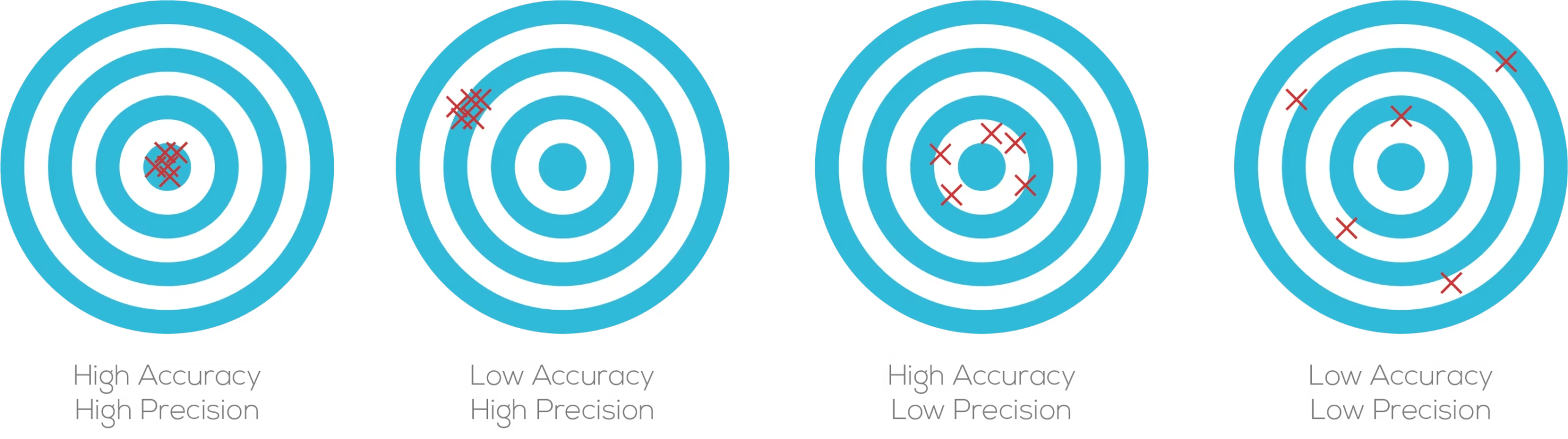
Accuracy = How close a measurement is to the true value.
Precision= How close several identical measurements are to each other.
Resolution = Smallest change in value that can be detected.
General
Higher resolution means that you will observe more detail, but this does not mean that you will also measure more accurately.
Thanks to a high resolution, the smallest details become visible. Precisely for this reason, people often think that the measurement is also more accurate. However, you should be aware that this also allows you to detect any noise in the scan data, such as dirt or dust particles, that would otherwise not be visible.
Scanner accuracy relates to how the scanner can perceive the projection, and then convert it to 3D data. All of this is determined by an underlying algorithm that establishes exactly how accurately this conversion is done. So this is fixed, but it can be positively or negatively affected with how much resolution you are going to observe all of this.
Since “perceiving” is not always done in exactly the same way, you have to take into account how you do the observing, and whether the product to be scanned is fully observable without adding extra things (e.g., scanning spray for translucent pieces).
It is precisely for this reason that you have to look critically at the objects to be measured each time, and make an estimate of which set-up to use to achieve a good/desirable measurement result.
Accuracy & Precision
Accuracy and precision are independent of each other. Precision refers to the degree to which the results of multiple measurements with the same instrument correspond.
Accuracy refers to the closeness of the measured value to a standard or true value. It can be affected by external factors such as changes in calibration, temperature or other environmental factors, among others. Accuracy is often divided into repeatability and reproducibility.
- Repeatability considers the variation that occurs when identical conditions are maintained, and repeated measurements are made within and short time period.
- Reproducibility, in turn, refers to the variation that occurs when the same measurement procedure is used by different operators over a long period of time.
Resolution
When we talk about resolution in CT scanning, we usually mean “spatial resolution.” This resolution is an indication of a system’s ability to distinguish small structures. This term is often confused with voxel size.
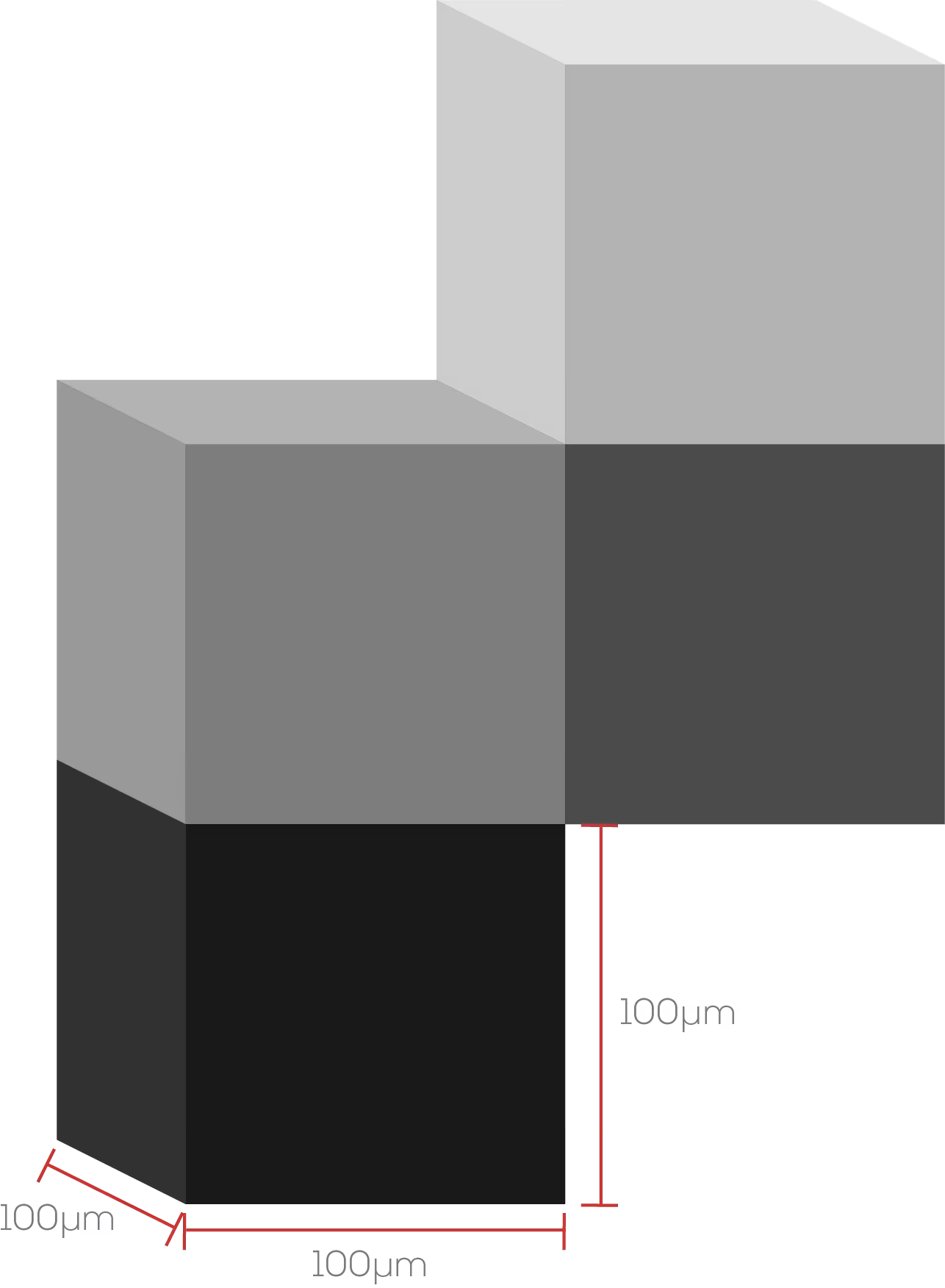
A voxel can be seen as a three-dimensional pixel. In CT scanning, these are the building blocks of the scan volume. Each voxel has known X, Y and Z dimensions and is assigned a certain gray value (= Hounsfield unit) corresponding to the average attenuation of all materials in the voxel.
The voxel size is defined as the actual distance each voxel represents within a CT dataset. Most CT scans are made with isotropic voxels. A smaller voxel size is often correlated with higher resolution, but there are a number of other factors that are co-determinants, viz:
- The size and number of detectors/detector elements
- The focal point of the x-ray beam
- The distance between the source, object and detector
The voxel size is not related to the achievable spatial resolution of the CT system. For example, when the X-ray spot becomes larger than the chosen voxel size, the spatial resolution of the system becomes worse.
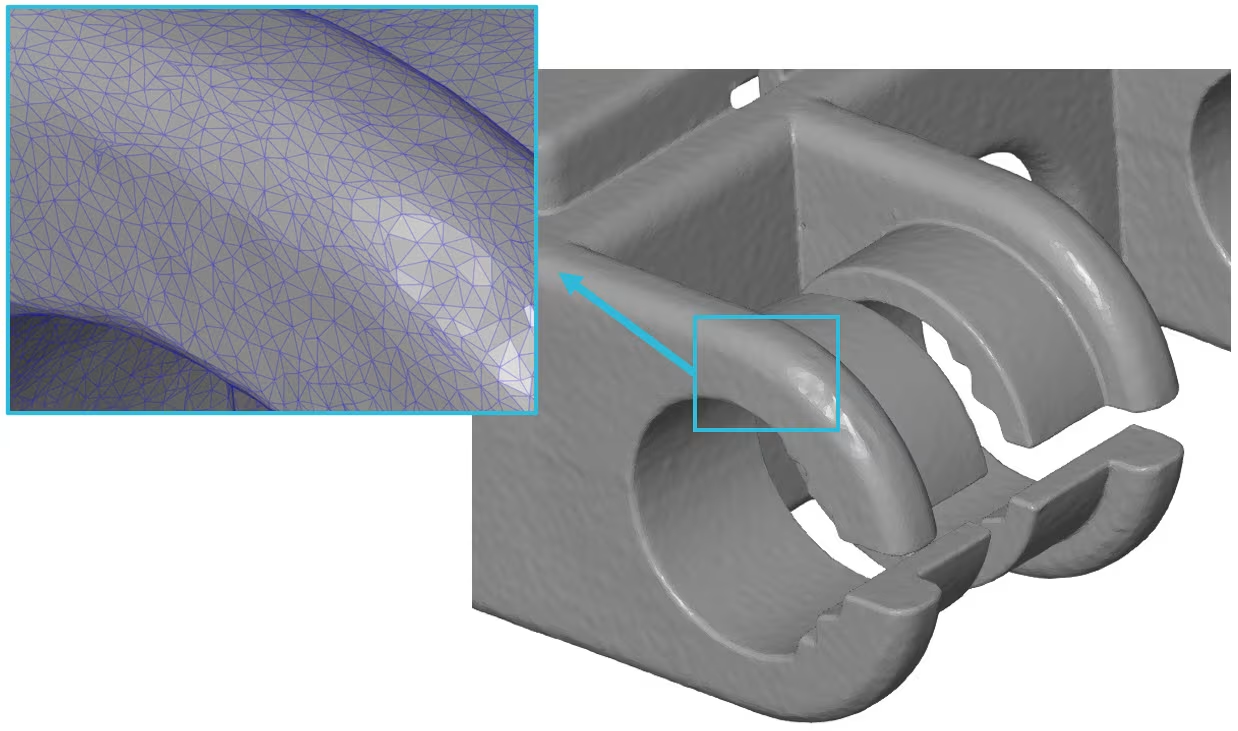
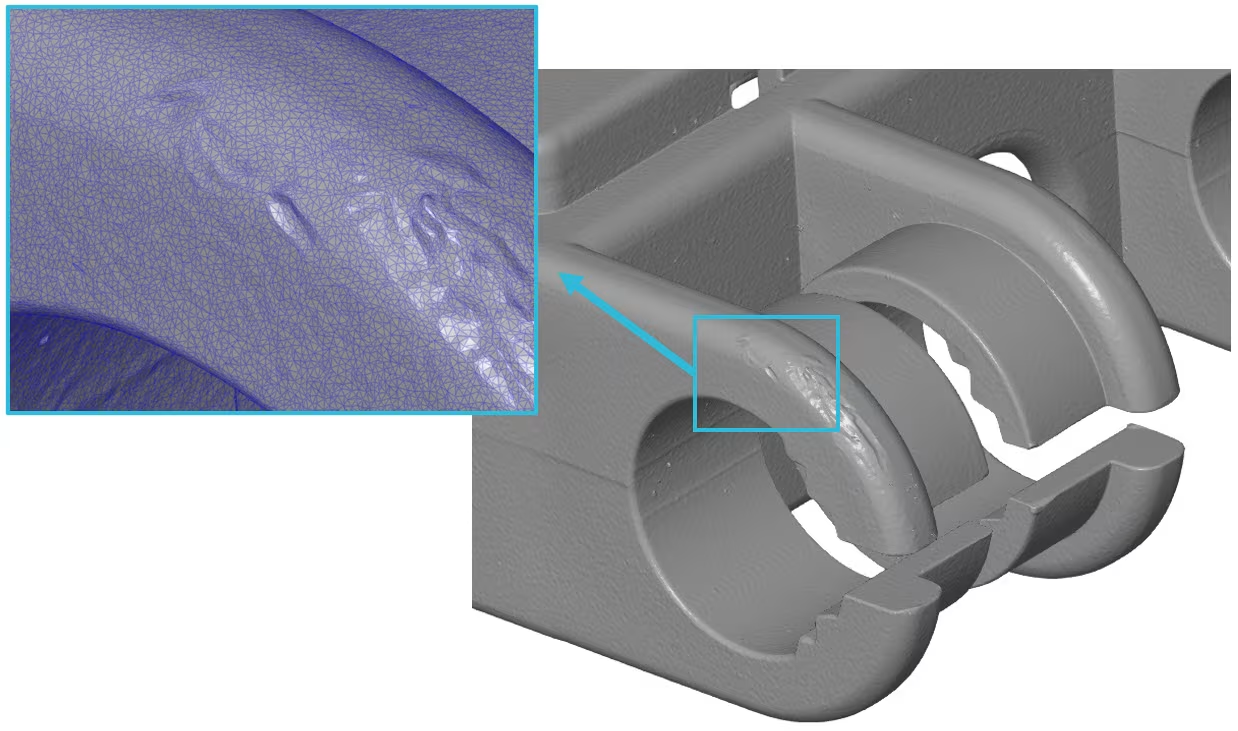
When we talk about resolution with a mesh (whether from a CT scanner or an optical scanner), we are talking primarily about the number of measurement points or triangles on a given surface. The closer these measurement points are together, the greater the resolution.
What exactly do you need?
Accuracy (and also a piece of precision) is needed if you want to check a certain size or dimension against a nominal size with an associated tolerance. In other words, it is the uncertainty on your measured value. This measured value can therefore be somewhat larger or somewhat smaller in reality. The size of the band in which the value may lie is the uncertainty. If this band is larger than the tolerance you want to go check, then your measurement system is not accurate enough because you can reject that dimension when in reality it would be right. So you want your uncertainty band to be a lot smaller than the tolerance you are going to check.
Generally, a factor of 1/3 to 1/10 is used in the industry. This indicates how large your uncertainty band may be relative to your tolerance band. Under our ISO17025 accreditation, we work with a factor of 1/3 as standard.
Precision or repeatability is especially needed when you want to compare two or more measurements.
For example, you can measure a particular product several times over a period of time. This allows you to observe the behavior and dimensional changes in the product.
Or another example: you could also start comparing two samples of the same product. Suppose one sample works perfectly and the other doesn’t work at all, but you don’t know where to start looking and at first glance they seem perfectly the same.
In both situations, of course, you need a certain accuracy, but most of all you want very good precision or repeatability. For this you will need to perform the measurements under the same conditions. Things to consider then are, f.e.: the setup, the spray, the same operator, the same scan settings, the same room temperature, etc.
Resolution you need to capture or measure certain features.
Suppose on your product you have a small rib somewhere 1mm in size. To measure this rib correctly you will want to fit a plane through the data. If you have a low resolution and only 1 or 2 measurement points on top of the rib, it will be impossible to fit a plane through it. So you need a much higher resolution to do this.
In a typical quality inspection, we always look for the smallest feature that remains to be measured. We then state that we need 5 to 10 measurement points on this feature. In the case of the rib, we would then need a measurement point every 0.1mm and thus also a resolution of 0.1mm.